PUPPY TRAINING GUIDES
Puppy training guides for real-life problems
Use these puppy training guides for clear, reward-based help with the skills and behaviors new puppy parents face most often.
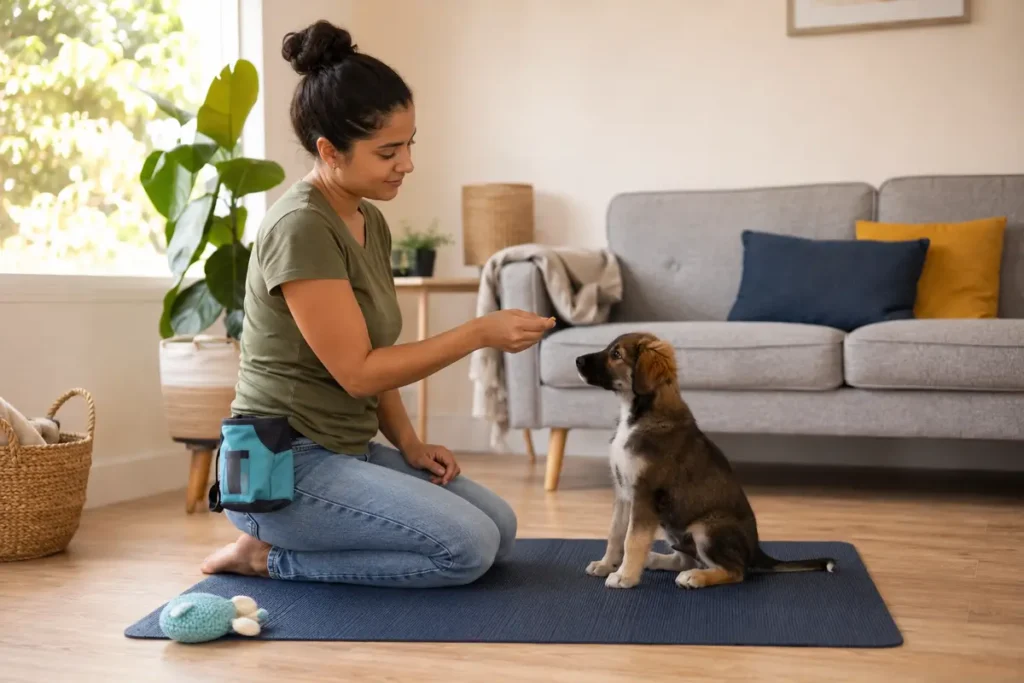
How to use these puppy training guides
Start with the problem that affects daily life most, then practice one small skill at a time. Puppies learn best when the setup makes the right response easy, the reward arrives promptly, and practice ends before either of you becomes frustrated.
Training is not a test of whether your puppy is “good.” It is a process of teaching, managing the environment, and repeating successful moments. Sleep, hunger, discomfort, fear, and an overly distracting setting can all make a familiar skill temporarily harder.
Choose the training problem you want to solve
Each guide focuses on a common puppy challenge and gives you a practical place to begin.
Dog training workshop
Read our overview of an online workshop covering focus, communication, and everyday manners.
Build a simple training rhythm
A few thoughtful repetitions are usually more useful than one long session. Try this rhythm during ordinary parts of the day:
- Prepare the setting. Reduce distractions, have rewards ready, and decide exactly what you will reinforce.
- Mark the useful moment. Use a consistent word such as “yes” or a clicker, then deliver the reward promptly.
- Keep the step achievable. Reward early success before asking for more duration, distance, or distraction.
- Pause while it is going well. A short successful session makes it easier to return to practice later.
- Use real-life rewards. Food is useful, but play, sniffing, access to the yard, and greeting a person can also reinforce behavior.
Management is part of training
Baby gates, pens, leashes used with supervision, closed doors, chew-safe areas, and a predictable schedule prevent a puppy from rehearsing unwanted behavior while new skills are developing. Management is not failure; it protects the puppy and makes learning clearer.
A properly fitted harness can support supervised leash practice without replacing training. Compare our puppy-harness picks for adjustable fit, padded walks, and tiny puppies.
If a behavior suddenly changes, consider health and comfort before treating it as a training problem. Pain, digestive upset, urinary problems, fear, and inadequate rest can all affect behavior. Contact your veterinarian when a new behavior is intense, persistent, or accompanied by physical symptoms.
What should a puppy learn first?
Prioritize skills that protect health, safety, and everyday cooperation. Your puppy does not need a long list of polished cues during the first weeks. A useful foundation includes:
- Responding to a name. Say the name once, mark the moment your puppy turns toward you, and reward that attention.
- Coming when called. Begin at a very short distance in a safe space and make reaching you consistently worthwhile.
- Comfort with handling. Pair brief touches of paws, ears, mouth, collar area, and body with rewards, and stop before the puppy struggles.
- Settling and resting. Reinforce calm choices and protect adequate nap time; an overtired puppy often bites, zooms, and loses focus.
- Trading and releasing objects. Offer something valuable in exchange instead of chasing, grabbing, or creating conflict.
Fit practice around a realistic puppy schedule, including meals, potty trips, naps, play, and quiet time. If your puppy has only recently arrived, the New Puppy 101 guide can help you balance training with health, safety, and adjustment.
Common puppy-training questions
How long should a training session last?
Many puppies do well with sessions lasting one to five minutes, sometimes even less in a distracting environment. Stop when attention fades, then practice again during another ordinary part of the day. Several brief sessions are easier to fit into family life and give a young puppy more chances to rest.
What if treats are not working?
Check the environment before assuming the puppy is stubborn. The reward may be too ordinary, the room may be too distracting, or the puppy may be tired, worried, full, or uncomfortable. Increase distance from distractions, simplify the step, try a different safe reward, or pause and meet the puppy’s immediate need.
Should everyone use the same cues?
Consistency helps. Agree on a short cue, the behavior it means, and the rules for common situations such as doors, furniture, greetings, and meals. Family members can sound different and move differently, so practice with each person while keeping the consequence for the desired behavior predictable.
Know when to get professional help
Seek qualified help for aggression, repeated biting that causes injury, intense fear, panic when alone, guarding, or behavior that puts a person or animal at risk. Look for a professional who explains the plan clearly, uses reward-based methods, and works with your veterinarian when medical or serious behavior concerns are involved.
Sources and further reading
- American Veterinary Society of Animal Behavior: Humane Dog Training Position Statement
- VCA Animal Hospitals: Puppy Behavior and Training — Training Basics
- VCA Animal Hospitals: Using Reinforcement and Rewards to Train Your Pet
Safety note: General training information cannot diagnose medical or behavioral conditions. Contact your veterinarian or an appropriately qualified behavior professional for individualized guidance.